
2025
From Manuscript to Monograph: A Workshop on Academic Publishing, Nov 20, 2025
What does it take to turn a dissertation into a book? How do you approach a publisher? What does the publication process entail? This workshop, hosted by the Berlin Program for Advanced German and European Studies, is devoted to helping rising scholars navigate the world of English-language academic publishing. We will discuss how to prepare your work for publication and feature a manuscript-in-progress as a case in point. The session will be hosted by Thomas O. Haakenson (professor, California College of the Arts, and series editor for Visual Cultures in German Contexts, Bloomsbury Academic) and Lea Greenberg (commissioning editor, Central European University Press). After a discussion of publishing more generally, we will focus on Haakenson’s current project Love in the Time of Fascism: Salomo Friedländer and Avant-Garde Resistance in Berlin.
The event is open to any students and faculty of the Freie Universität Berlin. Read more
**********************************************************************************
GSA Distinguished Lecture by B. Venkat Mani, Tuesday, Nov 18, 2025
Colonialism, Racism, and Human Dignity: On the Global Novel in an Age of Refugees
Drawing on his current book project, Tales of Unsettlement, in this paper Mani situates the figure of the refugee and the forced migrant at the center of contemporary novels. Mani proposes that “refugee” narratives reveal much more than just the plight and flight of refugees, which has largely been the focus of contemporary studies. Instead, Mani argues that novels of refuge open doors to reframe our thinking of histories of European colonialism and its morphed manifestations in contemporary Europe. Moving narratives of refuge from a marginal to a central space, Mani underlines, opens up possibilities of thinking of the European novel as a site of new political and aesthetic examination of race-, religion-, caste- and class-based discriminations in the contemporary era.
B. VENKAT MANI is Professor of German and World Literatures at the University of Wisconsin-Madison in the USA. He was former director of Center for South Asia and Center for Global Studies at UW-Madison. He is currently the Alexander von Humboldt Foundation’s Reimar Lüst Fellow (2025-26) at the German National Literary Archives (DLA-Marbach) in Germany, where he is working on his current book project. His publications include Cosmopolitical Claims (2007), Recoding World Literature (2017; winner of MLA and GSA awards for best book in German Studies), and as editor A Companion to World Literature (2020).
Paul Nolte, Freie Universität Berlin, will moderate the event. He is Professor of Modern and Contemporary History and chair of the Berlin Program’s Academic Advisory Committee. Read more
The German Studies Association (GSA) is the Berlin Program's cooperation partner and co-sponsor.
**********************************************************************************
Berlin Program Alumni Panel at the 49th Annual GSA Conference in Arlington, Virginia, Sept. 27, 2025
Holocaust Memory, Multiculturalism, and the Politics of Solidarity in Germany: 1980s to the Present
June Hwang, University of Rochester
We Are All… Until We Aren’t: Solidarity, Identity, and the Fraught Politics of Victimhood
Ludwig Decke, University of Wisconsin-Madison
“There Must Never Be a Second Holocaust!” Jews, Ausländerfeindlichkeit, and the Pursuit of Multicultural Germany
Leonie Ettinger, Trinity University
Unkus Heirs: Sinti and Roma of the Third Post-War Generation in the Struggle for Visibility and Remembrance
Lauren Crawford, Yale University
“False Tolerance”: German Feminists’ Judeo/Islamo-phobia and the Limits of Liberalism
Commentator: Paul Lerner, University of Southern California
Moderator: Jonathan Catlin, University of Rochester
Organized by Ludwig Decke and Leonie Ettinger
On the third day of the 49th German Studies Association Annual Conference, Saturday, September 27, 2025, around forty guests gathered in the National Landing III room of the Crystal Gateway Marriott in Arlington, Virginia (USA), to attend this year’s Berlin Program for Advanced German and European Studies Alumni Panel. In the small room—described by one colleague with a wink as “the good one,” since particularly engaging presentations had taken place there over the past couple of days—hardly a free seat remained when Berlin Program alumnus Jonathan Catlin opened the session as moderator.
The panel featured Berlin Program alumni June Hwang, Ludwig Decke, Leonie Ettinger, and Lauren Crawford, with Crawford unfortunately withdrawing at short notice for personal reasons. Her contribution is included here nonetheless, as it was part of the panel’s curation. Paul Lerner, a member of the Berlin Program’s Academic Advisory Board, served as commentator.
Bringing together historians (Crawford, Decke) and literary scholars (Ettinger, Hwang), the interdisciplinary panel examined the place of Holocaust memory in German public life. It addressed topics ranging from multiculturalism to Islamophobia, antisemitism, and antiziganism, sparking a rich debate about the extent to which the legacy of the Holocaust has facilitated—or foreclosed—solidarity among minoritized groups in Germany since the 1980s. Read the report by Leonie Ettinger.
**********************************************************************************
Geschichtsbewusstsein und Solidarität: Die dritte Nachkriegsgeneration zwischen Vergangenheit, Gegenwart und Zukunft am 7. Juli 2025
Gespräche I Diskussion I Lesung
mit Max Czollek, Luisa Banki, Jane Weiß, Dani Kranz, Linda Sabiers, Sharon Zelnick, Tamar Aizenberg, Mirah Langer, Kelly Labinger, Jon Catlin, Veronika Fuechtner und Emir Yigit
organisiert von Leonie Ettinger
Als sogenannte „Schwellengeneration“ zeichnet sich die dritte Nachkriegsgeneration durch ein fragmentiertes und vermitteltes Verhältnis zum Holocaust aus. Sie gehören zu den letzten, die Zeitzeug:innen noch persönlich in ihren Familien erleben konnten, doch ihr Wissen schöpfen sie oft nur aus vagen Erzählungen, indirekten Beobachtungen und abstrakten Dokumenten. Daher zeigen sie ein ausgeprägteres Bedürfnis nach historischer Auseinandersetzung als frühere Generationen. Ihre Kunst, Literatur und ihr Aktivismus widmen sich Fragen der Erinnerung, des Vermächtnisses und der historischen Weitergabe. Gleichzeitig wird die Vergangenheit mit aktuellen gesellschaftlichen Spannungen verknüpft und im Licht heutiger politischer Entwicklungen reflektiert. In Gesprächen zwischen Wissenschaftler:innen, Aktivist:innen und Künstler:innen, die größtenteils selbst zur dritten Generation zählen, werden transgenerationale Traumata, historisches Bewusstsein und Erinnerungskulturen thematisiert sowie Perspektiven für eine pluralistische, solidarische Zukunft ausgelotet. Hier finden Sie das Veranstaltungsprogramm.
**********************************************************************************
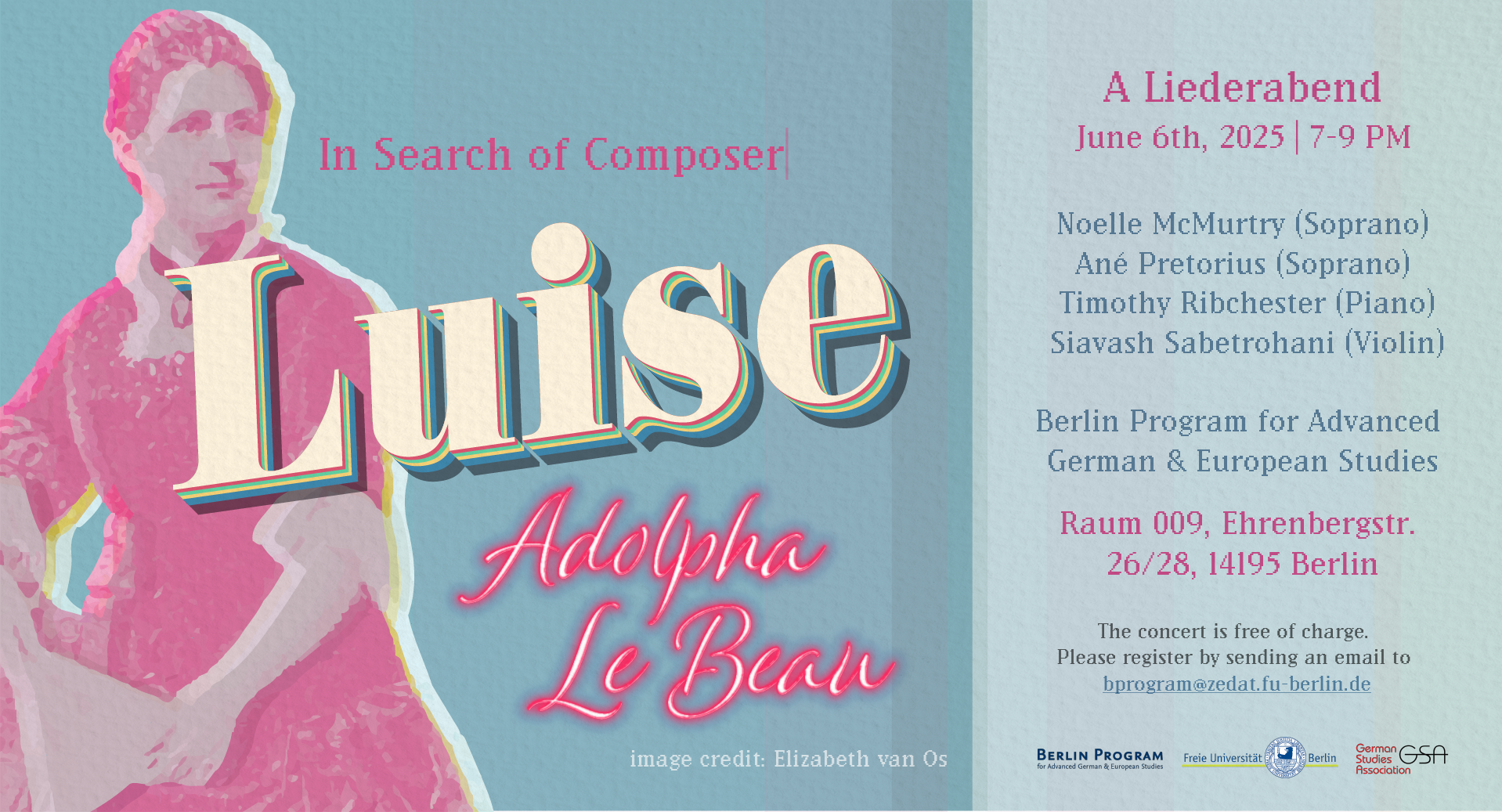
Luise Adolpha Le Beau (1850-1927) composed approximately twenty Lieder opuses, ten of which were published during her lifetime. With a career that spanned over four decades as a composer, concert pianist, music critic, and piano pedagogue, Le Beau both defied gender prejudice and expanded socio-cultural perceptions of female musical achievement in late 19th-century Germany.
Le Beau documented her struggles to succeed as a woman composer, most importantly through the 1910 publication of her memoirs Lebenserinnerungen einer Komponistin and the self-curation of her own Nachlass. By bequeathing her estate to state libraries in Berlin, Karlsruhe, and Munich, Le Beau hoped her music and life story would survive to earn an “unparteiischer und gerechter” assessment from future generations. Read more about this compelling musical and view the program.